
AMH Levels By Age: What Your Fertility Test Results Mean
Written by Dr. Archana Agarwal — MBBS, DGO | Fertility Specialist in Bangalore, Reproductive Medicine & Ovarian Reserve Assessment
AMH, anti-Müllerian hormone, has become the single most requested fertility blood test in the country. One result, one blood draw, and a woman is suddenly sitting with a number she is trying to make sense of on her own, usually on the internet, in a context that will either wave it away entirely or else catastrophise it at her.
Neither of those responses is accurate. So here is what it actually tells you.
What AMH Measures — and What It Doesn't
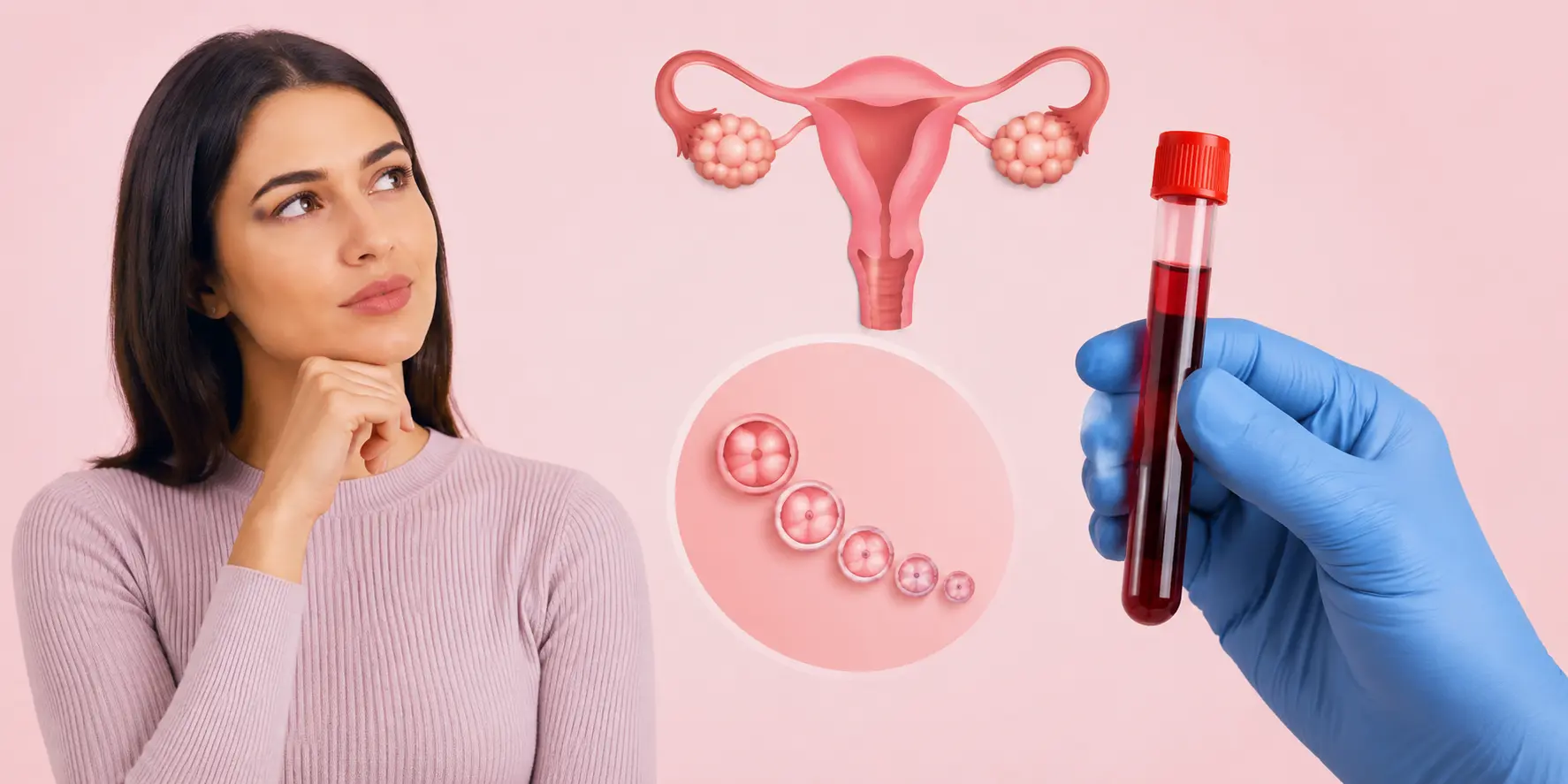
AMH is produced by the small, developing follicles in the ovaries. What its concentration in the bloodstream gives you is an indirect estimate of how many of those follicles remain, which is what clinicians call ovarian reserve. It measures egg quantity. Egg quality it does not measure at all, and that distinction matters a good deal more than most women realise when the result first lands in front of them.
A low AMH tells you the remaining pool of follicles is smaller than expected for your age. It does not tell you your eggs are chromosomally abnormal. Nor that you cannot conceive naturally, and by itself it will not tell you what your IVF outcomes are going to be either. Published data from PMC confirms as much, younger women with low AMH who undergo IVF show no significant difference in live birth rates against younger women with normal AMH, and that holds even though the number of eggs retrieved does differ between them. The reserve was lower. The quality was not lower along with it.
A high AMH, going the other way, does not mean effortless fertility. In women with PCOS the AMH is frequently elevated, simply because there are so many small follicles sitting there. Egg supply was never the problem in PCOS. Ovulation is. And a high AMH in that context is marking the condition, it is not marking an advantage.
What the Numbers Mean by Age
There is a curve to AMH across a woman's reproductive life and it is a well documented one, peaking somewhere in the mid-twenties, sliding away from around age 25 onward, and after 35 that slide gets noticeably quicker.
The clinically accepted reference ranges come off large cohort data, and broadly they run like this.
- Under 30, normal sits somewhere in the 2.0 to 6.8 ng/mL band
- 30–34: 1.7–5.0 ng/mL
- By the 35 to 39 bracket you are looking at 1.0 up to 3.5 ng/mL, and that is normal for the bracket
- 40–44 brings it down again, 0.5 to 2.5 ng/mL
- Over 44, anything below 1.0 ng/mL is common enough
Inside those ranges the individual variation is wide. Two women of the same age can carry AMH values that differ several-fold from one another and both of them still sit inside a normal distribution, and that is not a rare thing to see. Seifer et al. put cohort data behind it in Fertility and Sterility, thousands of women presenting to fertility centres, and the substantial individual spread was confirmed. So age-specific interpretation earns its keep. Any single absolute threshold does not.
Below 1.0 to 1.1 ng/mL is where low AMH is generally set. Severely low goes below 0.5.
What a Low Result Actually Means for You
A low AMH for your age group means fewer eggs are likely to come out of a stimulated cycle, and the natural window may well be a shorter one on top of that. Fertility preservation is where it bites hardest. If that is the goal, the egg freezing wants doing sooner rather than later, because the number of eggs that can be banked in any single cycle is likely to be lower.
What it does not mean, and in younger women especially it does not mean this, is that conception is impossible. Between AMH and natural conception, in women who are not using assisted reproduction at all, the relationship is a weak one. One good egg in a cycle is what natural conception asks for. That is the whole of the ask. And per-egg quality is the one thing AMH never measures.
What a High Result Means
An AMH above 4.0 to 5.0 ng/mL warrants its own conversation. In women with PCOS it will often be reflecting polycystic ovarian morphology, so a great many small follicles sitting there and not maturing as they should. For stimulation planning that is not a detail, it changes what you do. High-AMH patients carry an elevated risk of ovarian hyperstimulation syndrome through IVF, and both the protocol selection and the medication dosing have to be built around the level.
Dr. Archana Agarwal offers comprehensive ovarian reserve assessments here in Bangalore, the AMH testing, the AFC, a proper review of what your results actually mean for your own situation, and it matters little whether you are planning a family now, or turning egg freezing over in your mind, or simply trying to understand where your fertility timeline sits. Book a consultation and turn the result into a plan.
Frequently Asked Questions
1. Can AMH levels improve with supplements or lifestyle changes?
The evidence is limited. Most of it is low quality. DHEA, CoQ10 and inositol have been studied in the context of ovarian reserve. None has been shown to raise AMH reliably in a well-designed trial. Lifestyle matters more than supplements do. Not smoking matters. Maintaining a healthy weight matters. Not delaying investigation or treatment while you wait for the number to improve matters most of all, because the number does not improve on its own.
2. Does AMH predict whether I can get pregnant naturally?
Not reliably. AMH predicts ovarian response to stimulation. That means how many eggs a clinic can retrieve in a single cycle. Natural per-cycle conception probability is a different measure. AMH does not predict it with anything like the same accuracy. Natural conception needs one egg reaching maturity and being fertilised. It does not need a whole cohort of them. Women with low AMH do conceive naturally. The correlation with spontaneous fertility is weaker than it is usually presented to be.
3. How is AMH different from FSH?
FSH is follicle-stimulating hormone. It rises as ovarian reserve declines. It is an indirect marker and a reactive one. It climbs because the ovaries are having to work harder to produce eggs. AMH falls as reserve declines. AMH is the more direct marker of the two. AMH is also the more stable one, and it does not fluctuate significantly across the menstrual cycle. AMH can be tested on any day of the cycle. FSH is tested on day two or three. Neither marker alone gives the reserve picture that the two of them read together give.
4. Should I get my AMH tested even if I'm not trying to conceive now?
If you are over 30 and may want children at some point, yes. AMH gives you actionable information about your fertility timeline. Specifically it tells you whether that timeline is compressed relative to your age. It does not predict natural fertility cycle by cycle. It can flag whether egg freezing is worth discussing sooner rather than later.
5. Can I do IVF with a very low AMH?
Yes. The number of eggs retrieved per cycle is likely to be lower. That affects how many attempts may be needed. It also affects what a realistic outcome expectation looks like. A low number is not a bar to treatment. Protocol customisation can sometimes improve the response, through higher stimulation doses or adjuncts such as growth hormone. IVF remains a clinically appropriate option for women with low AMH. Age and egg quality carry as much weight in the outcome as the AMH number does.
