
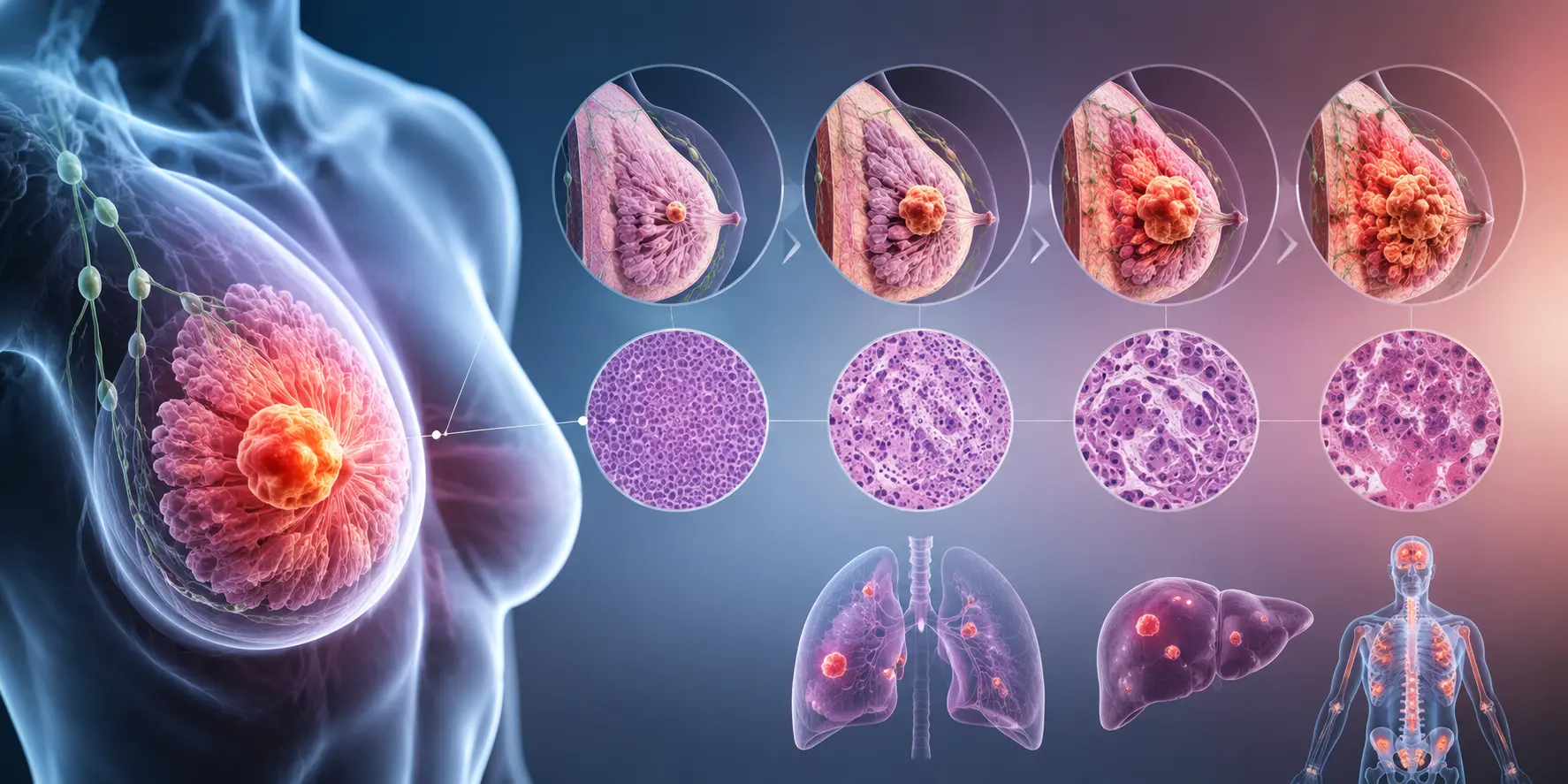
Breast Cancer Stages: Why Biology Matters As Much As Size
Written by Dr. Archana Agarwal — Breast Cancer Screening in Bangalore, Founder & Medical Director, Mannat Fertility Clinic
When people hear a breast cancer stage number, the assumption they reach for almost every time is that it maps straight onto tumour size — that a lower number just means a smaller cancer, and a higher one a bigger one. Under the older staging systems that was largely how it worked. Modern staging does not run that simply any more, and once you understand why, the questions worth asking at the point of diagnosis start to look quite different.
How Staging Works Now
The American Joint Committee on Cancer, the AJCC, is now on the 8th edition of its breast cancer staging system, and it runs two frameworks side by side. The anatomic stage is the familiar one — tumour size (T), lymph node involvement (N), distant spread (M), the TNM system people have heard of. The prognostic stage takes all of that and adds more to it: the tumour grade, and the biomarker status, which means the oestrogen receptor (ER), the progesterone receptor (PR), and HER2.
Now, in most countries it is the prognostic stage that is preferred for actually making clinical decisions. What that means in practice is that a cancer's biology is built formally into its staging, not just its physical extent. Take a small stage I tumour that is ER/PR-negative and HER2-positive — on biology alone it may get upstaged prognostically, because that profile behaves worse than its size suggests. And it runs the other way too. A slightly larger tumour that is strongly hormone-receptor-positive and low-grade may end up treated less aggressively, because its biology points to a slower course.
What Each Stage Broadly Means
Stage I and Stage II are the early-stage cancers. The tumour is still held within the breast, or it has reached only the nearby lymph nodes and no further. Five-year relative survival at stage I sits at roughly 96%; at stage II, around 86%. Both are usually treatable with surgery, whether that is a lumpectomy or a mastectomy, and what gets added on top of the surgery comes down to the biological profile.
Stage III is locally advanced disease — larger tumours, or spread into several lymph nodes, but nothing that has travelled to the distant organs yet. Five-year survival for stage IIIA–B, treated the way it should be, comes in around 86%, though the tumour biology moves that figure about quite a bit. At this stage we often bring in neoadjuvant chemotherapy, meaning chemotherapy given before surgery, to shrink the tumour down first.
Stage IV is metastatic — the cancer has gone to other organs. Here the treatment is aimed at management rather than cure. Having said that, the advances in targeted therapy and immunotherapy over the last decade have genuinely extended both survival and quality of life at this stage, well beyond where things stood even ten years ago.
Why Tumour Grade Matters Alongside Stage
Tumour grade is a separate thing from stage. It describes how abnormal the cancer cells look down the microscope, and how fast they are likely to grow. Grade 1, the low-grade tumours, tend to be slow. Grade 3, the high-grade ones, are the aggressive ones.
And this is the part that surprises people — two women can carry the exact same TNM stage and face very different prognoses, purely on grade. Grade feeds straight into treatment decisions too, including the big one of whether chemotherapy gets recommended on top of the surgery and the hormone therapy.
This is the practical reason the whole shift toward biology-inclusive staging matters. Treatment planning follows the tumour biology now, more and more, and not simply the tumour size.
The Fertility-Oncology Conversation
For a woman of reproductive age, a breast cancer diagnosis tends to arrive with a second question attached, and a time-sensitive one: what happens to fertility? Chemotherapy — the cyclophosphamide-containing regimens in particular — can pull down the ovarian reserve, or bring on premature ovarian insufficiency altogether.
Freezing eggs or embryos before the chemotherapy starts is the established route for preserving fertility. But the window is a short one. The referral to a fertility specialist has to happen at the same time as the oncology planning, not tacked on afterward once treatment is already under way.
At Mannat Fertility Clinic, Dr Archana work alongside the oncologists to support fertility preservation planning for women going into breast cancer treatment — because the conversation needs to be had before treatment begins, not after it has closed the door.
Frequently Asked Questions
1. What do breast cancer stages 1 through 4 mean?
Stage I is a small tumour held inside the breast, with no lymph node involvement or only minimal — highly treatable, five-year survival around 96%. Stage II means a slightly larger tumour, or spread into a small number of the nearby nodes. Stage III is locally advanced — the larger tumours, or spread into several nodes, but not yet to the distant organs. Stage IV, the metastatic stage, means the cancer has reached other parts of the body; treatment there is about management and quality of life, though the advances in targeted therapy have improved those outcomes considerably.
2. Why does tumour biology matter as much as tumour size?
Two tumours of an identical size can behave nothing alike, depending on their grade and their receptor status. A low-grade, oestrogen-receptor-positive tumour is usually slow, and it responds well to hormone therapy. A high-grade, triple-negative one grows aggressively and needs chemotherapy. The AJCC 8th edition took these biological factors — the tumour grade, and the ER, PR and HER2 status — and built them formally into the prognostic stage, which reflects what the evidence keeps showing: biology predicts the outcome and steers the treatment every bit as much as the anatomical extent does.
3. What does HER2-positive mean in breast cancer?
HER2 is a protein that drives cell growth. A HER2-positive breast cancer carries too many copies of the HER2 gene, and that makes it grow more aggressively than a HER2-negative one. But there is another side to it. HER2-positive cancers respond to the targeted therapies, trastuzumab among them, that block the HER2 receptor specifically — and that has improved outcomes for this subtype a great deal. So knowing the HER2 status is essential to the treatment planning, not only to the prognosis.
