
Adenomyosis Vs Fibroids: Key Differences And Treatment Options
Written by Dr. Archana Agarwal — MBBS, DGO | Fibroids Treatment Surgeon in Bangalore with Over Two Decades of Specialist Experience
Two conditions with nearly identical symptoms, very different structures underneath them and very different treatment paths, and in clinical practice the two of them get confused with one another a great deal more often than they ought to be.
Adenomyosis and fibroids are both common causes of a bulky uterus, of heavy bleeding, of pelvic pain. What they actually are, though, is not the same thing at all.
What Is the Actual Difference?
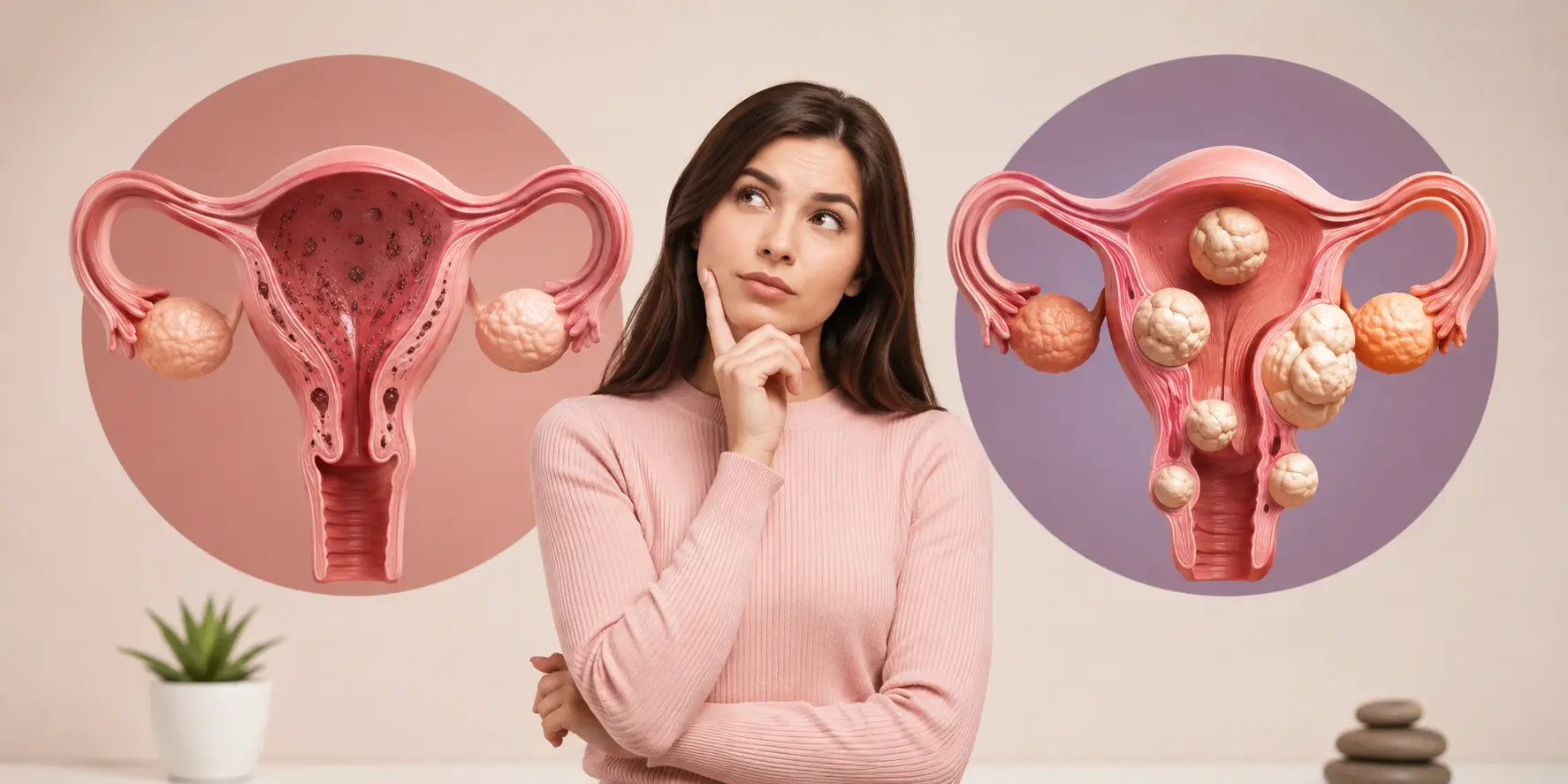
Fibroids, or uterine leiomyomas, are discrete well-defined tumours arising out of the smooth muscle of the uterine wall. They form as separate masses, identifiable and mappable and, in most cases, surgically removable. That is what makes fibroids treatment in Bangalore a well-structured clinical conversation, there is usually a clear target to aim at.
Adenomyosis differs in kind and not merely in degree. Here the inner lining of the uterus, the endometrium, grows directly into the muscular wall of the uterus itself, diffusely, without ever forming a discrete mass at all. The uterus enlarges and it thickens globally with it. There is no single structure to remove. What you are dealing with is not a tumour, it is an infiltration.
Both conditions share a hormonal driver in estrogen dependence, which is partly why they so often coexist in the same patient, and partly why the overlapping symptom profile makes accurate diagnosis so important.
Why Bulky Uterus Causes Matter for Treatment
One of the most common causes of a bulky uterus is adenomyosis. Fibroids are another. And then a good number of patients turn out to have both of them together. The reason this distinction matters is that what you do about each one is fundamentally different.
For fibroids, laparoscopic myomectomy removes the fibroid while preserving the uterus, and the evidence shows fertility outcomes equivalent to open surgery in appropriate candidates. Where the fibroids are submucosal, hysteroscopic resection is performed through the cervix, with no incision at all.
For adenomyosis there is no equivalent excision. The tissue is not a discrete mass that anybody can take out. Medical management does control symptoms, so hormonal suppression, the levonorgestrel IUS, the GnRH antagonists, and in some cases surgical ablation or uterine artery embolisation may help as well. In severe, treatment-resistant cases, in women who have completed their family, hysterectomy is the only definitive option there is. That difference in the treatment ceiling is precisely why the correct diagnosis matters from the outset.
How Are They Diagnosed?
The symptoms overlap almost entirely between the two conditions, heavy and prolonged periods, pelvic pain, painful intercourse, a sensation of fullness or pressure in the pelvis, which is why clinical history on its own cannot reliably distinguish them.
Transvaginal ultrasound is the standard first-line investigation. Fibroids show up as distinct hypoechoic masses, and their size, their number, their position relative to the uterine cavity can all be mapped with good accuracy. Adenomyosis is harder to detect on a standard ultrasound. What you are looking for there is a heterogeneous, asymmetrically thickened myometrium, often with small cystic spaces sitting within the muscle.
Where standard ultrasound comes back inconclusive, MRI gives considerably better soft-tissue detail, and it is the most accurate non-invasive test we have for adenomyosis. A 2024 PMC study on preoperative diagnosis noted that adenomyosis is frequently misdiagnosed as fibroids preoperatively, and that transvaginal ultrasound specificity for adenomyosis remains imperfect, which rather underscores why advanced imaging and specialist assessment matter.
Dr. Archana Agarwal, with over two decades of experience in laparoscopic surgery and gynaecological care in Bangalore, evaluates each case with a full review of imaging, symptoms and fertility plans before recommending any intervention. Whether the cause turns out to be fibroids, or adenomyosis, or both of them, the management plan wants building on an accurate diagnosis rather than on assumptions drawn from overlapping symptoms. Book a consultation to understand exactly what you are dealing with and what your options are.
Frequently Asked Questions
1. Can adenomyosis and fibroids occur at the same time?
Yes, and they frequently do. Both conditions are estrogen-dependent and share a similar hormonal environment, which is partly why the coexistence is so common. Where both are present the treatment planning becomes more nuanced, because myomectomy addresses the fibroids and does nothing at all for the adenomyosis, so symptom relief after surgery may well be incomplete if the adenomyosis component has not been addressed separately.
2. What are the main causes of a bulky uterus?
The most common causes are adenomyosis, uterine fibroids, or a combination of the two. Less commonly a bulky uterus can result from endometrial hyperplasia, or from pregnancy, or, rarely, from uterine malignancy. Accurate imaging is needed to work out which condition is responsible, and in some cases that means MRI, since symptoms and clinical examination alone cannot reliably distinguish between them.
3. Is adenomyosis curable without surgery?
There is no cure for adenomyosis short of hysterectomy, which is the only definitive treatment for it. Having said that, the condition is managed, and often very effectively, with medical options including the levonorgestrel IUS, hormonal suppression, and the newer oral GnRH antagonist class. For a great many women, particularly those who still want to conceive, medical management is the appropriate path, with hysterectomy kept back for cases where the symptoms are severe and family building is complete.
4. Can fibroids be removed without affecting fertility?
Yes, in most cases. Laparoscopic myomectomy and hysteroscopic myomectomy both remove fibroids while preserving the uterus, and the evidence shows equivalent fertility outcomes between laparoscopic and open myomectomy in appropriate candidates. The main risk to ovarian reserve comes from fibroids sitting very close to the ovaries, or from repeat surgeries, which is one reason the decision to operate should weigh the fibroid's actual impact on fertility against the surgical risk.
5. How do I know if my heavy periods are caused by fibroids or adenomyosis?
From symptoms alone, you cannot reliably tell, the two present almost identically. A transvaginal ultrasound is the standard first step, though adenomyosis can be missed on standard imaging. MRI gives better soft-tissue detail and is more accurate for adenomyosis specifically. A specialist assessment that takes your imaging and your symptom pattern and your history all together is what gives you a reliable answer.
