
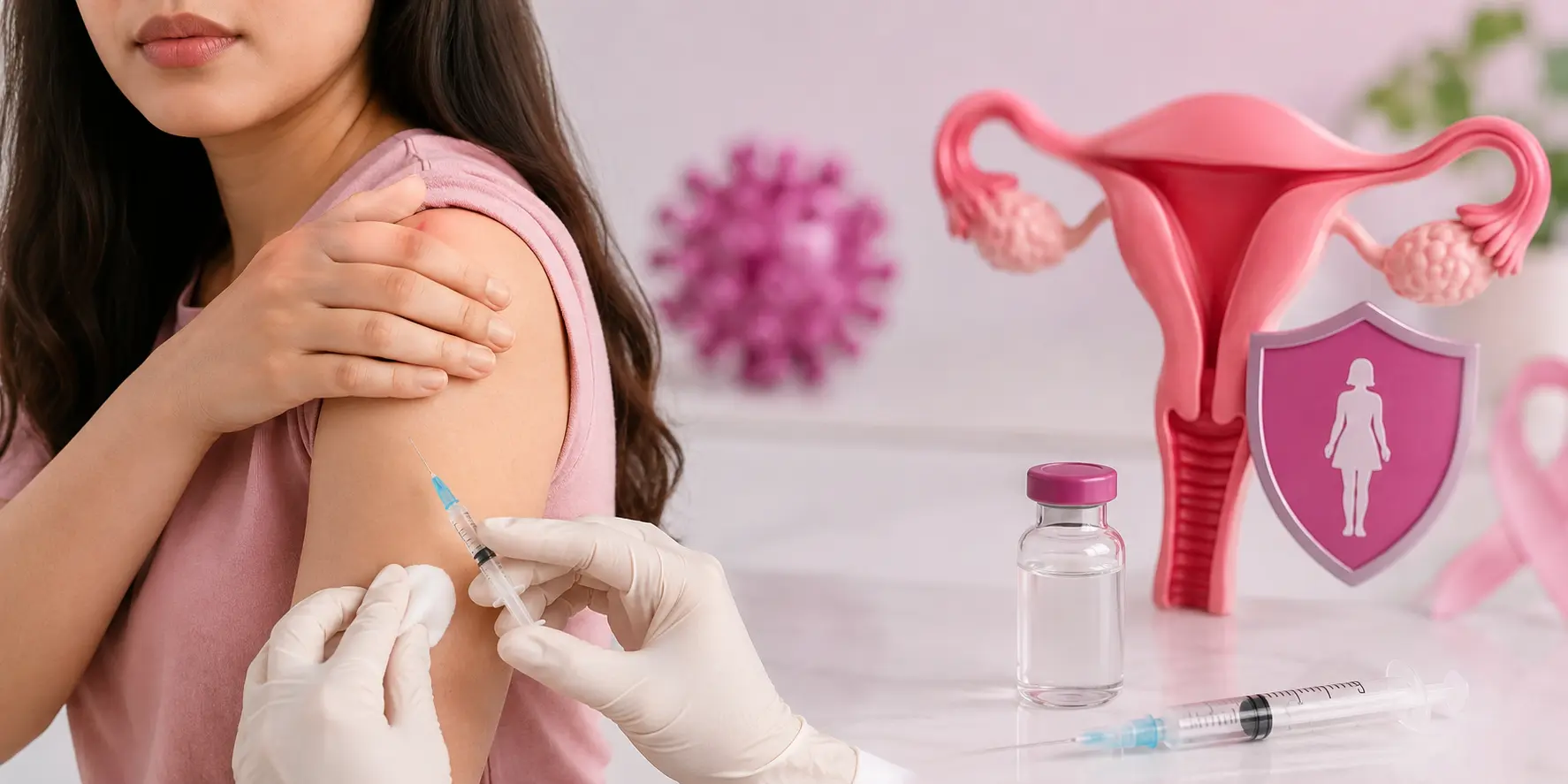
HPV Vaccine For Women: Age, Cost & Cancer Prevention
Written by Dr. Archana Agarwal — MBBS, DGO | Gynaecologist & Women's Cancer Prevention Specialist in Bangalore, 20+ Years in Preventive Women's Health
Cervical cancer is, by a considerable margin, one of the most preventable cancers in women. The human papillomavirus is responsible for virtually all cases of it, and there is now a vaccine that protects against the high-risk strains driving the majority of that risk. What has not kept pace with the availability of that vaccine is the clarity most women have about it, about who should have it, and when, and what it can and cannot do.
What HPV Is, and Why It Matters
HPV, human papillomavirus, is a group of more than 200 related viruses, most of them transmitted through skin-to-skin contact, sexual contact included. Most HPV infections clear on their own, no treatment needed at all. It is the subset that does not clear which causes the problem. Persistent infection with high-risk strains, HPV 16 and 18 particularly, causes around 70% of cervical cancers globally, along with a proportion of vulvar, vaginal, anal and oropharyngeal cancers.
According to the WHO, cervical cancer is the fifth most commonly diagnosed cancer in women globally, with approximately 604,000 new cases and 280,000 deaths in 2024. The burden falls disproportionately on low- and middle-income countries, and India is among them, where screening coverage remains low and late-stage diagnosis is common.
The pap smear test and the HPV vaccine together form the two-pillar prevention strategy. Vaccination reduces the risk of infection from the highest-risk strains. Cervical screening detects precancerous changes where infection has already occurred. Neither one stands in for the other.
Which Vaccine, and What Does It Cover?
There are currently three main HPV vaccines in use globally. The bivalent, covering HPV 16 and 18. The quadrivalent, which adds 6 and 11, and those two are what cause most genital warts. And the 9-valent Gardasil 9, which covers nine strains, so 31, 33, 45, 52 and 58 on top of the four the quadrivalent already has.
The 9-valent vaccine, asreviewed in PMC research on HPV vaccine effectiveness, is recommended for individuals aged 9–45 in the United States, and it offers the broadest coverage there is against HPV-related disease, cervical cancer and genital warts and several other HPV-associated cancers among it. In most specialist settings it is the current standard.
Age: Who Should Be Vaccinated, and When?
The vaccine is most effective given before any sexual exposure to HPV at all, which is the reason the WHO's global strategy targets girls aged 9–14 as the primary vaccination group. Antibody responses run strongest in that age group. And where vaccination begins before age 15, a two-dose schedule, the two given six months apart, is sufficient.
From age 15 onward a three-dose schedule is recommended, at 0, 1-2 and 6 months, because the immune response sits somewhat lower once there has been potential prior exposure. Vaccination up to age 26 is routinely recommended. Beyond that, up to age 45, it becomes a shared clinical decision, the benefit being lower for older women who may already have met several HPV strains, though there can still be protection against the strains they have not yet encountered.
A key clarification worth making. Vaccination does not treat an HPV infection you already have. What it does is prevent future infection from the strains the vaccine includes. That is why earlier is better, and it is also why a woman who has already been sexually active can still benefit from vaccination, since she is unlikely to have been exposed to all nine strains the 9-valent vaccine covers.
Cost of HPV Vaccine in Bangalore
The HPV vaccine is available in India as Gardasil 4 or Gardasil 9, with Cervarix, the bivalent, also available in some centres. Pricing varies by centre and by vaccine type. Gardasil 9 typically ranges from ₹3,000–₹5,000 per dose in private clinics, which puts the full three-dose schedule at ₹9,000–₹15,000. Government vaccination programmes periodically make the vaccine available at subsidised or no cost for adolescent girls, so checking with your local health authority is worth doing before you default to private pricing.
Dr. Archana Agarwal provides HPV vaccination, pap smear testing, and breast screening in Bangalore as part of a comprehensive women's preventive health service. If you have not been vaccinated, or have not had a pap smear inside the recommended interval, or simply want to understand what your preventive screening ought to look like at your age, a consultation is the right place to start.
Frequently Asked Questions
1. Can I get the HPV vaccine if I am already sexually active?
Yes. Being sexually active does not mean you have been exposed to all nine strains the 9-valent vaccine covers. Vaccination can still give you meaningful protection against the strains you have not encountered. The benefit is greatest for women vaccinated before any HPV exposure at all, but it is not zero for those vaccinated later on. Make the decision in consultation with your doctor, and particularly so if you are over 26.
2. Does the HPV vaccine protect against all types of cervical cancer?
The 9-valent vaccine covers the nine HPV strains responsible for approximately 90% of cervical cancers. The remaining 10% it does not cover, and that is why regular cervical screening stays essential even after vaccination. The vaccine and the screening programme work alongside each other. One is not a substitute for the other.
3. How many doses of the HPV vaccine do I need?
That depends on your age at the first dose. Girls beginning before age 15 need two doses, six months apart. Women beginning at 15 or older need three, so a baseline dose, another one to two months later, and the third six months after the first. All three are needed for full protection in that age group.
4. Is the HPV vaccine safe?
The HPV vaccines have been given to hundreds of millions of people globally and they carry one of the most extensively monitored safety profiles of any vaccine currently in use. Common side effects are mild and local, so soreness or redness or swelling at the injection site, and occasionally a brief dizziness after the injection. Serious adverse events are very rare, and post-marketing surveillance data has not established them as causally related to the vaccine.
5. What age should my daughter receive the HPV vaccine?
The WHO recommends vaccination for girls aged 9–14 as the primary target group, before the onset of sexual activity. That age window produces the strongest immune response and it needs only two doses rather than three. In India girls can have the vaccine from age 9 onward through private clinics, and in some states through government immunisation programmes. Check the current national immunisation schedule and local availability for current guidance.
