
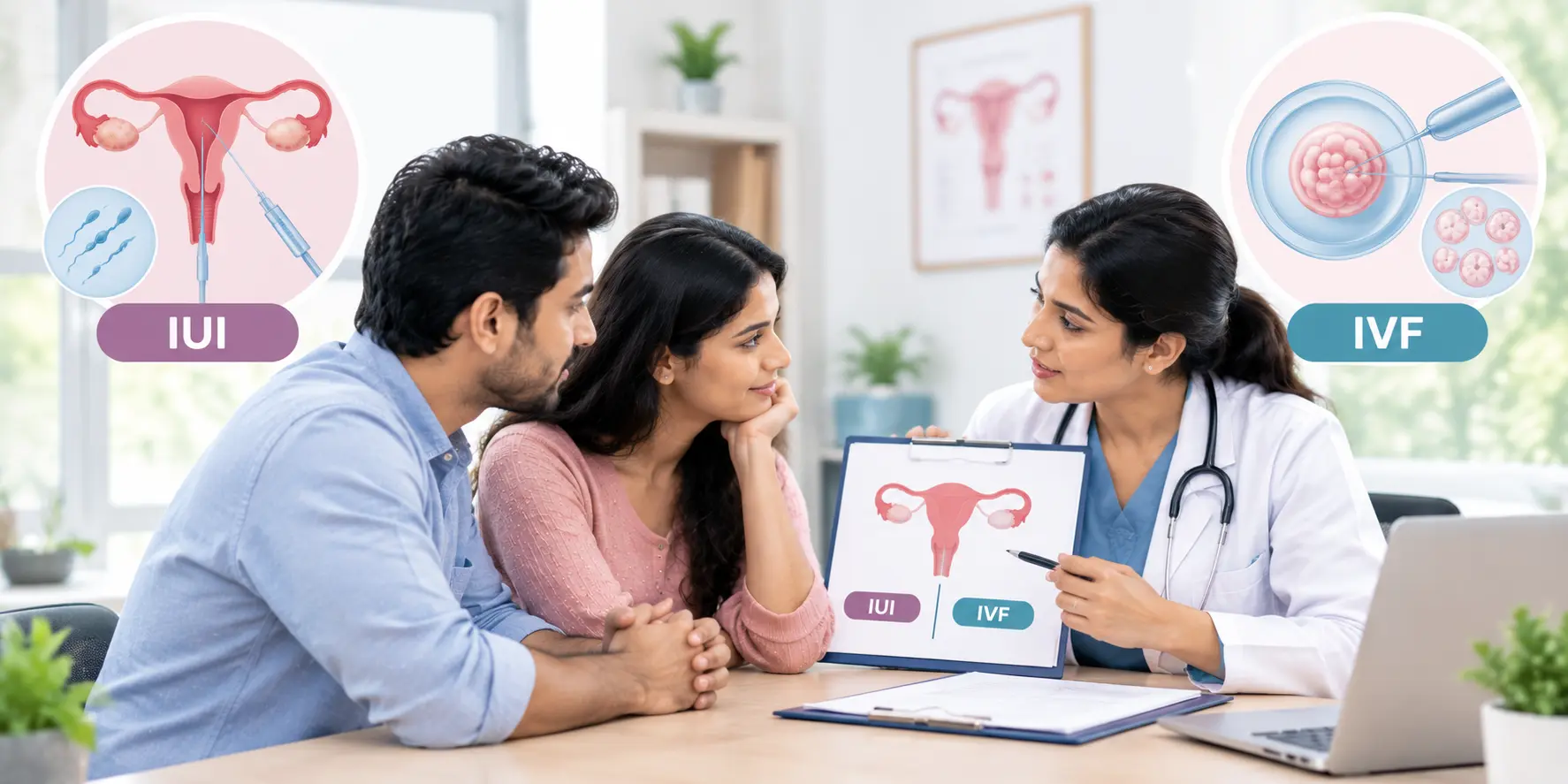
IUI Vs IVF: How To Know Which Fertility Treatment Fits Your Situation
By Dr. Archana Agarwal, Gynecologist & Fertility Specialist | 4 min read
The IUI vs IVF decision comes down to one thing: where fertilisation happens. IUI places prepared sperm into the uterus and leaves fertilisation to the body. IVF removes the eggs, fertilises them in the laboratory and returns an embryo. Neither is universally better. IUI suits mild, specific obstacles, while IVF suits anything that needs the process taken over rather than assisted.
What Is the Fundamental Difference?
IUI, or intrauterine insemination, separates the better quality sperm from the sluggish and abnormally shaped ones and places the concentrated sample directly into the uterus around ovulation. Fertilisation still has to happen inside the fallopian tube on its own.
IVF collects your eggs surgically, fertilises them in a dish, grows embryos for three to five days and transfers one. The thing to note here is what that second route buys you, which is observation. Nothing in an IUI cycle can be watched or graded, whereas every stage of an IVF cycle can.
How Do Success Rates Compare?
This is usually the deciding factor. The HFEA states plainly that IUI success rates are generally around a third of those for IVF, while costing roughly a quarter as much per attempt.
|
Factor |
IUI |
IVF |
|
Fertilisation happens |
Inside the body |
In the laboratory |
|
Relative success per cycle |
Around a third of IVF |
The higher of the two |
|
Relative cost per cycle |
Around a quarter of IVF |
The higher of the two |
|
Invasiveness |
Low, no retrieval |
Higher, includes retrieval |
|
Embryo selection possible |
No |
Yes |
|
Best suited to |
Mild, specific obstacles |
Complex or multiple factors |
Read those two rows together, because a cheaper cycle with a third of the success is not automatically the cheaper route to a baby.
Who Is IUI a Good Fit For?
- Donor sperm use: IUI is the standard route where there is no female fertility factor, including for single women and same sex couples
- Unexplained infertility: Where a full assessment of both partners has found nothing, with ovarian stimulation added
- Cervical factor: Where mucus or previous surgery makes natural sperm migration difficult
- Ovulation problems including PCOS: Once induction has confirmed you are ovulating, timing the insemination to it can help
IUI is not suitable where the tubes are blocked, where endometriosis is significant, where ovarian reserve is low or egg quality poor, or where there is a meaningful male factor. A mild male factor sits on the border and is a case by case judgement rather than a rule.
When Is IVF the Better Starting Point?
IVF is often the right first step rather than a fallback, and it is recommended where there are blocked or damaged tubes, severe male factor requiring ICSI, advanced maternal age or diminished reserve, moderate or severe endometriosis, previous failed inseminations, or a need for genetic testing of embryos.
You might not be aware that IVF also opens options IUI cannot: embryo freezing, genetic screening and, for many couples, a considerably shorter overall time to pregnancy.
What About Cost Over the Whole Journey?
Per cycle, IUI treatment is clearly the cheaper option. Across a journey the arithmetic can reverse, because three or four unsuccessful inseminations can approach the cost of one IVF cycle with nothing to show for the time spent. Where your predicted IUI success is low, starting with IVF is frequently cheaper per baby and always faster.
Wrapping Up
This is a decision to make with a specialist rather than a search engine, because it turns on your age, your diagnosis and your ovarian reserve. A full fertility assessment of both partners converts a confusing choice into a clear recommendation, and it is the step to take before committing to either route.
Frequently Asked Questions
How many IUI cycles should I try before moving to IVF?
Most specialists reassess after three to four attempts. Beyond that the per cycle odds do not improve, and for women over 35 the time cost of continuing usually outweighs the saving.
Is IUI painful?
No. It takes a few minutes, needs no anaesthetic and most women describe mild cramping similar to a period. You can return to normal activity the same day.
Does a failed IUI mean IVF will fail too?
No. IUI failure usually reflects its lower per cycle probability rather than a problem IVF cannot address, which is why many couples conceive on their first cycle after several failed inseminations.
This article is for general educational purposes and is not a substitute for personalised medical advice from your fertility specialist.
