
Endometriosis Explained: Why Diagnosis Takes Years And How To Speed It Up
By Dr. Archana Agarwal, Gynecologist & Fertility Specialist
Do you know how many women of reproductive age are living with endometriosis? It is roughly one in ten of them, which makes it one of the most common gynecological conditions which we see in practice. It is also one of the slowest to be diagnosed anywhere in medicine, because the average woman waits seven to ten years before anybody names it for her. So what this means is that the difficulty here is very rarely the treatment itself. The difficulty is the time which passes before any treatment is offered to you at all.
What Is Endometriosis and What Does It Do Inside Your Body?
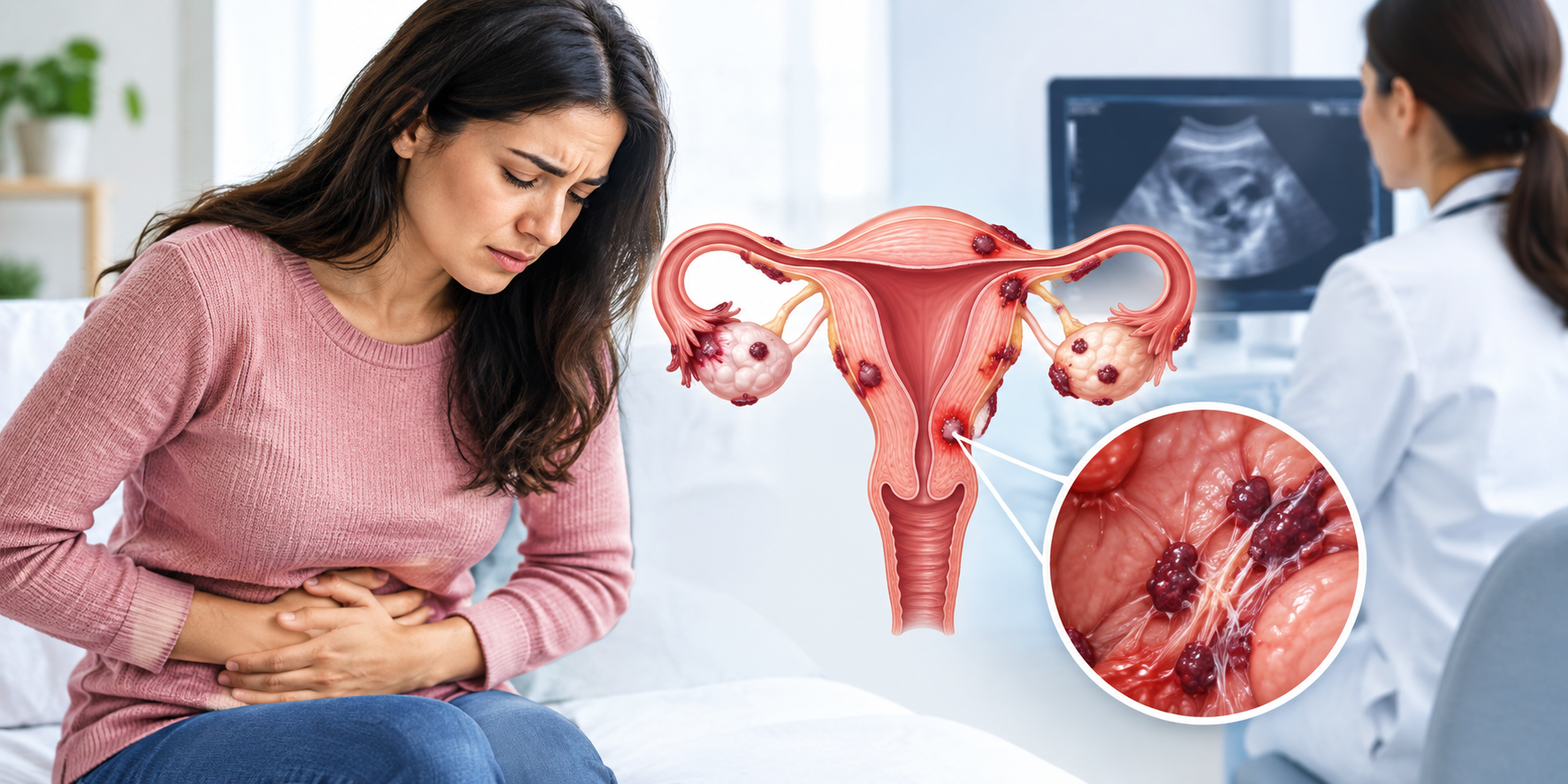
Endometriosis is a chronic condition in which tissue similar to the lining of your uterus grows in places outside the uterus, and the places it settles in most often are your ovaries, your fallopian tubes and the other organs sitting in your pelvis. This tissue is not passive at all. It responds to your hormones every month exactly as the lining inside your uterus responds, so it thickens, it bleeds and it inflames whatever sits immediately around it.
The difference, and it is the one which explains everything else, is that blood shed inside your uterus leaves your body while blood shed outside it does not. It stays where it is, your body attempts to deal with it, and so what this means is that over months and then over years what accumulates in that space is inflammation, scarring and pain which does not settle.
Which Symptoms Should Make You Suspect Endometriosis?
It is important for you to know that the severity of what you feel does not tell you how much disease is present, because a small amount can be intensely painful while a larger amount is sometimes barely noticed. These are the symptoms which bring women to us most often:
- Period pain which disables you, where the pain removes the day from you rather than being something you push through with a painkiller
- Pelvic pain outside your period, where the discomfort turns up in the middle of your cycle and not only when you are bleeding
- Pain during intercourse, where it is felt at the time and sometimes for hours afterwards as well
- Painful urination or painful bowel movements, where the pain is worst during the act itself
- Bleeding which has become heavy, where your flow is heavier than it has previously been for you
- Fatigue, where sleep does not correct it
- Difficulty in conceiving, where this is very often the symptom which finally brings a woman for an assessment
Why Does the Diagnosis Take Seven to Ten Years?
From the first symptom to the confirmed diagnosis, the average time is 7 to 10 years, and the average patient visits 7 doctors before diagnosis. These were not years when women were doing nothing; most women sought assistance early and were assured that they would be. These were not years when women were not doing anything, but rather they were seeking help at the beginning and were told that they would be. The delay is located within the pathway itself at 5 different points:
- There is no test to quickly determine the answer, as in the present day no laboratory test is reliable enough to diagnose or rule out endometriosis, so no tests are ordered on a first visit which can confirm or eliminate the diagnosis.
- The definitive test has been surgical: a laparoscopy – a big ask for a woman who has been told for years that there is nothing wrong with her.
- The symptoms are attributed to other conditions, such as IBS, urinary infections and, quite often, anxiety, and during each of these false turns, months are wasted, months that can turn to years.
- Severe period pain is treated as normal, where it is ignored first by those around her and lastly by herself, and she forgets to complain about it.
- The waiting is not over, as the longest single wait is often the time spent between the day she sees a gynecologist and the day she is given the diagnosis.
What Does the Delay Actually Cost You?
You might not be aware, but waiting does not leave the disease where it was. Endometriosis is progressive in many women, and this is borne out by the evidence, because it is found to be more advanced in women whose diagnosis has been delayed. Lesions which are not treated continue doing what they do, scarring accumulates on top of them, and your fertility can be affected by the two of them together.
Moreover, there is a second cost which will never appear on a scan or in a report. It is what it does to a woman to carry pain which nobody explains to her while she is being quietly disbelieved about it, and that wears down mental health and quality of life just as surely as the disease wears down tissue. The thing to note here is that both costs are smaller the earlier the condition is identified.
How Is Endometriosis Diagnosed Now?
Diagnosis is no longer the surgical matter it was for so long, and several routes towards an answer are available to you:
- A detailed symptom history, where this is the essential starting point because clinical suspicion drives everything which follows
- Transvaginal ultrasound, where ovarian cysts and some deep disease can be detected
- MRI, where it is increasingly accurate both for confirming lesions and for mapping them
- Laparoscopy, where it remains the definitive method and allows diagnosis and treatment in one sitting
The recent guidelines now recommend that treatment be offered on the basis of clinical suspicion and imaging rather than everybody waiting for surgical confirmation first. So what this means for you is that where an ultrasound or an MRI is used early, the wait can be shortened very considerably.
What Can You Do to Get Diagnosed Faster?
There is a great deal within your own control here, and it is recommended that you use all of it:
- Arrive with a written record, where you have tracked the timing, the severity and the effect on your daily life, because a pattern written down is much harder to set aside than the same thing described from memory
- Describe what the pain prevents, where you explain the work you have missed, the sleep you have lost and the plans you have cancelled, rather than rating the pain out of ten
- Use the word itself, where asking whether this could be endometriosis is what opens the correct line of investigation
- Request imaging, where this means a specialist transvaginal ultrasound or an MRI rather than a routine scan
- Go for a specialist in endometriosis or in minimally invasive gynecologic surgery, where you feel you are not being heard by the doctor you are seeing now
Your pain is real, the condition behind it is treatable, and it is never too late for you to get an answer, even where several wrong answers have already been given to you. Dr. Archana Agarwal takes period pain and pelvic symptoms seriously from the very first conversation, and if you suspect endometriosis in yourself, it is recommended that you do not give it another year.
This article is for general educational purposes and is not a substitute for personalised medical advice from your fertility specialist or embryologist.
