By Dr. Archana Agarwal, Gynecologist & Fertility Specialist | 4 min read
A hysteroscopy lets your gynecologist look directly inside the uterus through a thin lighted telescope passed along the natural passage, so there is no incision anywhere on the body. It usually takes 10 to 15 minutes, many cases are done as an outpatient visit, and most women are back to normal activity within a day or two with period-like cramping for a short while.
What Is a Hysteroscopy?
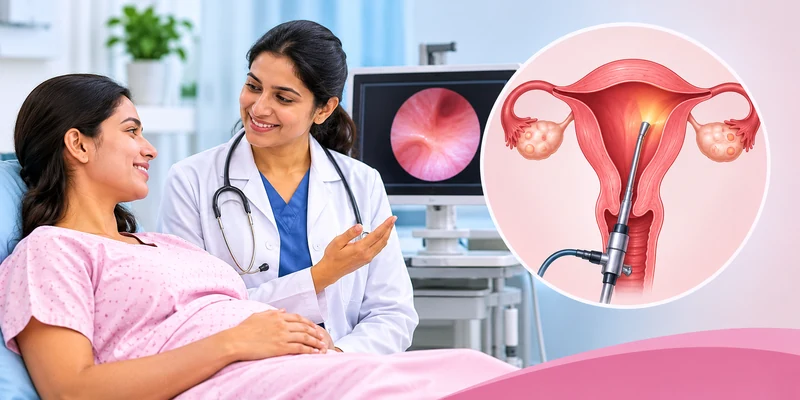
A hysteroscope is a narrow instrument carrying a light and a tiny camera. It passes through the vagina and cervix into the uterus and sends a magnified view to a screen, which is why no cut is needed, and a gentle fluid expands the cavity so the view is clear.
There are two forms, and often they become one procedure.
-
Diagnostic hysteroscopy: Used purely to look and identify what is causing a problem
-
Operative hysteroscopy: Used to treat the problem in the same sitting, with fine instruments passed down the hysteroscope
Why Is a Hysteroscopy Recommended?
The NHS lists the usual reasons as heavy periods, bleeding between periods, bleeding after menopause, fibroids, polyps, fertility problems and a missing coil thread. In practice that covers a wide range of situations.
-
Abnormal bleeding: Heavy, irregular or postmenopausal bleeding where the cause is not yet clear
-
Polyps and fibroids: Specifically those projecting into the cavity, which is where they interfere most
-
Fertility problems and recurrent miscarriage: Assessing the shape and lining of the cavity directly
-
Adhesions: Scar tissue inside the uterus, which can be divided during the same procedure
-
A displaced IUD or retained tissue: Located and removed under direct vision
-
A targeted biopsy: Taken from the exact area of concern rather than blindly
Why It Matters Particularly in Fertility
Submucosal fibroids, endometrial polyps and intrauterine scar tissue all sit in the space an embryo has to implant into. So what this means is that a cavity problem can quietly undermine good embryos, and correcting it is one of the few fertility interventions where the before and after is visible on a screen.
What Happens During the Procedure?
|
Aspect |
Diagnostic |
Operative |
|
Purpose |
Examine only |
Examine and treat |
|
Typical duration |
10 to 15 minutes |
Longer if tissue is removed |
|
Anaesthesia |
Often none, or local |
Commonly sedation or general |
|
Setting |
Usually outpatient |
Outpatient or day case |
Pain relief is tailored, ranging from ibuprofen or paracetamol beforehand, through gas and air or a local anaesthetic, to sedation or a general where more work is expected.
What Does Recovery Actually Look Like?
-
Cramping: Period-like pain for a couple of days, which simple pain relief handles
-
Spotting: Light bleeding or discharge for up to about a week, which is expected
-
Activity: Most women resume normal routine within a day or two, often the same day after a diagnostic look
-
Tiredness: More noticeable if you had a general anaesthetic
It is recommended that you avoid exercise, intercourse and tampons until the pain and bleeding stop, which lowers the infection risk while the cervix is still settling.
When Should You Call the Clinic?
Serious complications are uncommon, but four signs are worth acting on the same day: bleeding which worsens or carries on beyond a few days, pain which painkillers are not touching, a high temperature, or a foul-smelling discharge.
Wrapping Up
Hysteroscopy shows where gynecology has moved, towards seeing clearly and fixing precisely, with recovery in days instead of weeks. If one has been recommended, ask which version is planned and what will be done if something is found, because the answer changes your day rather than your week.
To discuss whether it applies in your case, book a hysteroscopy consultation or a review of an existing scan report.
Frequently Asked Questions
Will a hysteroscopy affect my fertility?
No. It does not reduce fertility, and where a polyp, fibroid or adhesion is removed from the cavity it may improve the chance of implantation rather than harm it.
How soon after a hysteroscopy can I try to conceive?
Usually from your next cycle, once bleeding has settled. Where larger fibroids or extensive adhesions were treated your specialist may ask you to wait a little longer.
Is it done under general anaesthetic?
Not always. A diagnostic hysteroscopy is frequently done with no anaesthetic or a local, while operative cases more often use sedation or a general depending on what needs doing.
This article is for general educational purposes and is not a substitute for personalised medical advice from your gynecologist.

Dr. Archana Agarwal
Gynaecologist, obstetrician and fertility specialist in Marathahalli and Whitefield, Bangalore, with over 20 years of experience in IVF, IUI, ICSI, laparoscopic surgery and high-risk pregnancy.
This article is for general information only and is not a substitute for professional medical advice. Please consult a doctor about your specific situation.