
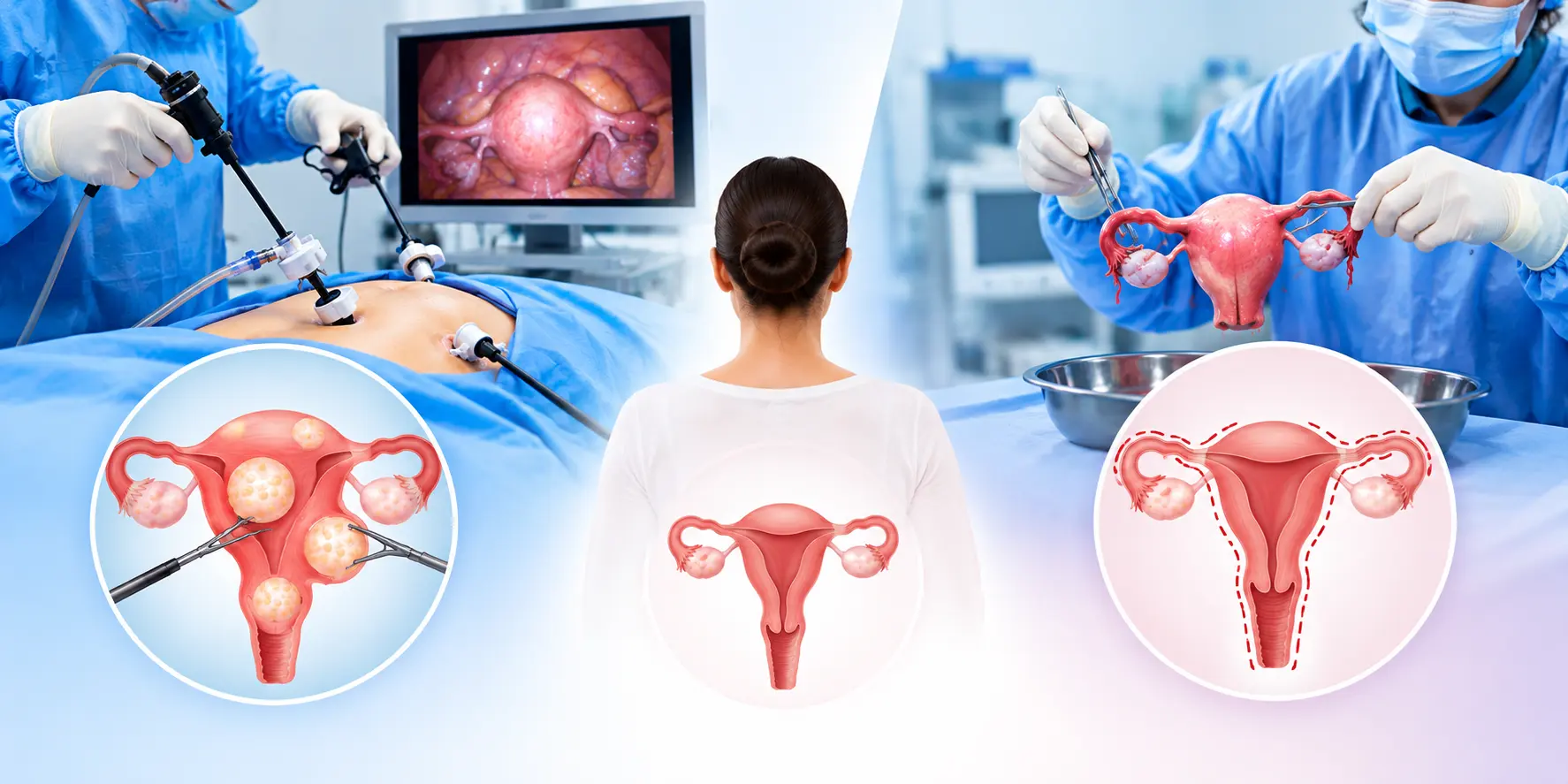
Laparoscopic Myomectomy Vs Hysterectomy: Which Fibroid Treatment Is Right For You?
By Dr. Archana Agarwal, Gynecologist & Fertility Specialist
When fibroids cause symptoms which are serious enough to need surgery, one question rises to the top very quickly. Should you keep your uterus, or should you have it removed? The choice between a laparoscopic myomectomy and a hysterectomy is among the most personal decisions in the whole of women's health, because it touches your fertility, it touches your recovery, and it touches the way you feel about your own body.
Dr. Archana Agarwal treats this as a shared decision, since there is no single right answer here; there is only the answer which is right for you. Here is what you need to know in order to weigh the two against each other.
What's the Difference Between the Two Procedures?
Both of these are common and effective surgeries for fibroids, but what they achieve is very different.
- Laparoscopic myomectomy takes out the fibroids and leaves the uterus itself intact. It is the gold-standard treatment for women wishing to preserve their uterus and their fertility.
- Hysterectomy removes the uterus entirely. Because the uterus is no longer there, fibroids can never come back, and this is what makes it the one definitive cure there is.
The trade-off which sits at the centre of all this is straightforward enough. A myomectomy preserves the possibility of pregnancy, but it carries a chance that fibroids will recur, while a hysterectomy ends your trouble with fibroids permanently and ends your fertility along with it.
Who Is a Good Candidate for Myomectomy?
Myomectomy is generally the preferred option for a woman who wants to keep her uterus, whether that is for fertility or for reasons which are entirely personal to her. It suits those who:
- Wish to preserve fertility, or hope to become pregnant in the future
- Have fibroids which are manageable in number and in size
- Would prefer to keep the uterus for personal or emotional reasons
- Are willing to accept that new fibroids may develop later on
It is worth being honest with you about recurrence. A myomectomy removes the fibroids which are there now, but it does not prevent new ones from forming afterwards. Many women go on to enjoy years of relief, though some do develop new fibroids further down the line.
Who Is a Good Candidate for Hysterectomy?
Hysterectomy may well be the better choice for a woman who has completed her family and who wants certainty from the outset. It is often considered when:
- Childbearing is complete, and fertility is no longer a goal
- Fibroids are very large, or numerous, or they keep recurring
- Symptoms are severe, and the other treatments have already failed
- A woman would prefer a permanent, one-time solution
One study of fibroid surgery found that symptom relief was achieved in 95% of hysterectomy cases versus 82.5% of myomectomies, and that reflects the definitive nature of removing the uterus. However, this certainty comes at the cost of ending fertility permanently, and for some women the loss of the uterus carries an emotional weight which is worth discussing openly before anything at all is decided.
How Do Recovery and Outcomes Compare?
Recovery depends heavily on the surgical approach which is used, but here is a general comparison of the two laparoscopic procedures.
|
Factor |
Laparoscopic Myomectomy |
Laparoscopic Hysterectomy |
|
Uterus |
Preserved |
Removed |
|
Fertility |
Maintained |
Ended |
|
Fibroid recurrence |
Possible |
Never |
|
Symptom relief |
High |
Highest (definitive) |
|
Typical recovery |
Around 4 to 6 weeks |
Around 2 to 4 weeks |
|
Main consideration |
Recurrence, uterine healing |
Permanent, emotional adjustment |
A myomectomy often requires a slightly longer recovery, which is around 4 to 6 weeks to allow the uterine wall to heal, compared with the 2 to 4 weeks which follow a laparoscopic hysterectomy. Both of them are minimally invasive, and that means smaller incisions, less pain afterwards and faster healing than you would get from traditional open surgery.
What About the Risks?
Both procedures are generally safe in experienced hands, although each one comes with its own considerations. A myomectomy carries a small risk of significant bleeding and, rarely, the need to keep an eye on the uterine scar during a future pregnancy.
A hysterectomy, being the more definitive of the two, removes any future risk from fibroids, but it ends fertility permanently, and if the ovaries are removed as well, then it can bring on menopause. Choosing a surgeon who is genuinely experienced reduces the risk of complications meaningfully, whichever of the two approaches you go with.
How Should You Decide?
This decision belongs to you, and it is guided by expert advice rather than dictated by it. The factors which matter most in weighing it up are your reproductive goals, the size and the number of your fibroids, how severe your symptoms have become, and how you personally feel about keeping or removing your uterus. As one decision-making guide puts it, the best treatment is the one that aligns with your goals and your values.
Dr. Archana Agarwal takes the time to understand what matters most to you before we recommend any path at all. Whether you choose the fertility-preserving route of a laparoscopic myomectomy or the definitive certainty of a hysterectomy, the goal stays the same, which is lasting relief and a return to living your life on your own terms. If you are weighing these options up, we would be glad to talk it through with you in detail.
This article is for general educational purposes and is not a substitute for personalised medical advice from your fertility specialist or embryologist
