
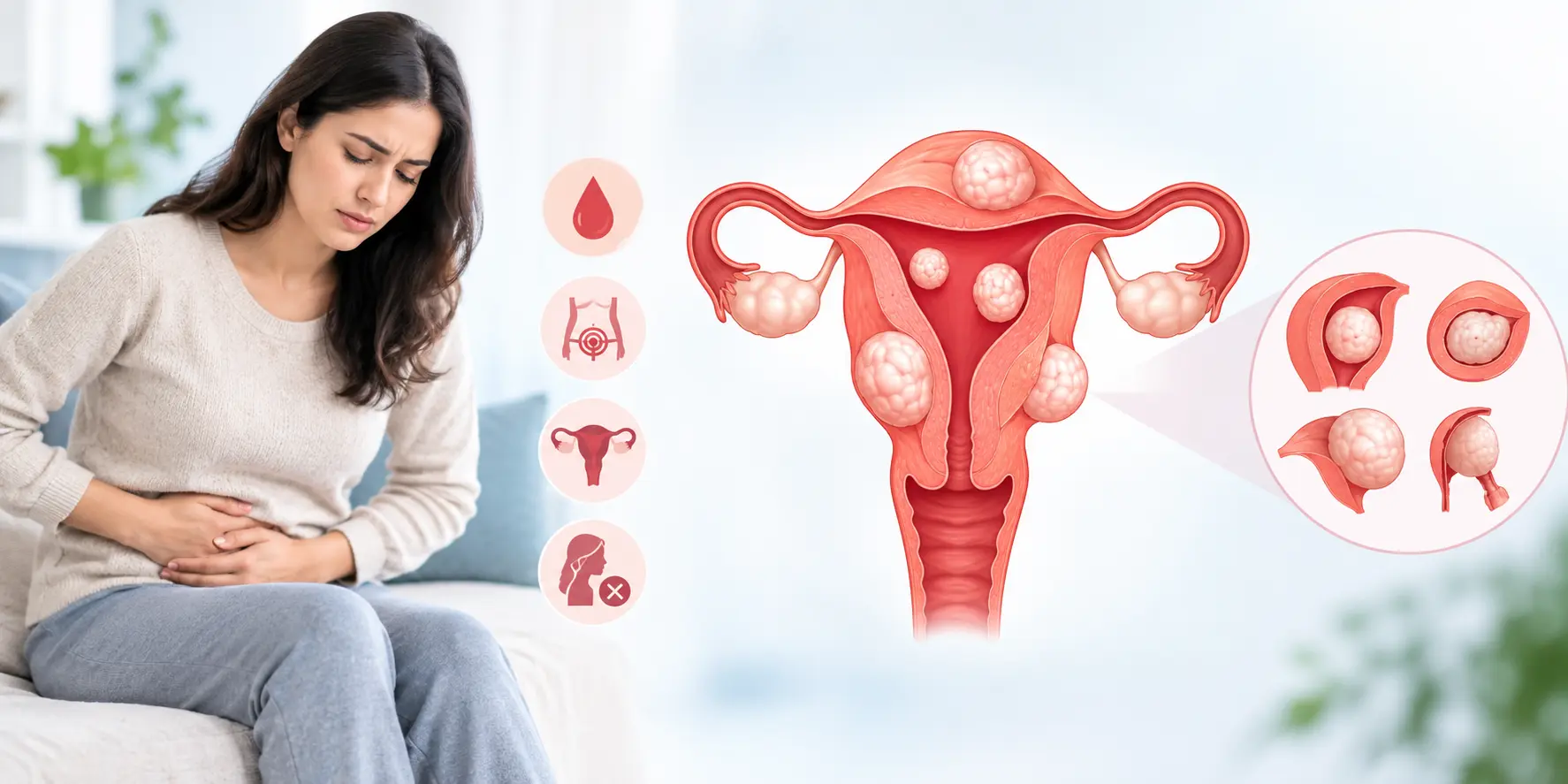
Uterine Fibroids: Types, Symptoms & When Treatment Becomes Necessary
By Dr. Archana Agarwal, Gynecologist & Fertility Specialist
Do you know that most women who have uterine fibroids never find out that they have them? It is true, and this is the reason fibroids are at the same time the most common condition we see in women's health and the most misunderstood one.
Some women carry them for years and live perfectly normally, while other women find that heavy bleeding, pain or a constant feeling of pressure has taken over their days. Dr. Archana Agarwal believes that understanding what fibroids actually are, which type you are dealing with, and when they genuinely need treatment is what lets you make a calm decision instead of an anxious one.
Fibroids are almost always benign, and there are more options available to you today for managing them than there have ever been.
What Are Uterine Fibroids?
Fibroids, which your doctor may also call uterine leiomyomas, are non-cancerous growths made of smooth muscle and fibrous tissue, and they develop either inside the wall of the uterus or on its surface. They are extremely common.
By the age of 50, more than 70% of women will have developed at least one of them. However, only a portion of these women ever run into trouble, because roughly 20 to 50% of the women who have fibroids experience symptoms which are significant enough to need attention.
The thing to note here is that two women can have what looks like the same fibroid on a scan and have completely different experiences of it, and the reason for that comes down to one single factor, which is location.
What Are the Different Types of Fibroids?
Fibroids are classified according to where they are growing within the structure of the uterus, and that position is what largely decides the symptoms you end up with.
- Intramural fibroids: these are the most common type, and they grow within the muscular wall of the uterus itself. As they expand, they can bring on heavy bleeding, pelvic pain and an enlarged uterus.
- Submucosal fibroids: these ones grow just beneath the inner lining and bulge into the cavity of the uterus. They are less common, but they tend to cause the most severe symptoms relative to their size, which means heavy bleeding and difficulties with fertility, and the reason is that they distort the very space in which an embryo would need to implant.
- Subserosal fibroids: these grow outward from the outer surface of the uterus. Instead of heavy bleeding, what they typically produce are the symptoms we describe as bulk symptoms, so pelvic pressure, a bladder which feels urgent, and backache, all of which happen because the fibroid is pressing on the organs sitting nearby.
- Pedunculated fibroids: the least common of the lot, and these are attached to the uterus by a stalk, which may sit inside the cavity or outside it.
What Symptoms Do Fibroids Cause?
A large number of fibroids cause no symptoms whatsoever, and a woman may go through years of her life without suspecting anything at all. When symptoms do appear, what you experience varies widely depending on the type of fibroid you have and on how big it has become. The common signs include:
- Menstrual periods which are heavy, or which go on for longer than they used to
- Passing large blood clots, along with cramping that is severe
- A feeling of pelvic pressure, or a sense of fullness
- Frequent urination, or difficulty in emptying the bladder completely
- Pain during intercourse
- Fatigue, weakness or breathlessness, which comes from the anemia that chronic blood loss causes
- Difficulty in conceiving, or recurrent miscarriage, in some cases
Anemia deserves a mention of its own here, because bleeding heavily month after month can leave a woman exhausted and genuinely unwell for a long time before anybody connects it back to the fibroids.
How Are Fibroids Diagnosed?
Fibroids are often picked up for the first time during a routine pelvic examination, when the uterus feels enlarged or irregular to the examining hand. However, an examination on its own cannot tell one type of fibroid apart from another, and this is the reason confirmation usually involves one of the following:
- Ultrasound, either transvaginal or abdominal, which is the most common first line of imaging
- MRI, which is used when detailed mapping of the size, the number and the exact location is needed before treatment is planned
- Hysteroscopy, where a camera is passed through the cervix so that submucosal fibroids can be viewed directly
Accurate mapping matters more than most people assume, because the type and the position of a fibroid directly shape which treatments are going to work for you.
When Does Treatment Become Necessary?
This is the question we are asked more often than any other, and the answer to it is a reassuring one. Not every fibroid needs treating. Small fibroids which are causing you no symptoms usually require nothing more than monitoring. Treatment becomes appropriate at the point where fibroids start causing problems which are meaningful to your life.
|
Situation |
Typical approach |
|
No symptoms, small fibroids |
Watchful waiting with periodic review |
|
Heavy bleeding or anemia |
Medication or a targeted procedure |
|
Bulk symptoms/pressure |
Procedure to shrink or remove |
|
Fertility concerns |
Uterus-preserving surgery |
|
Rapid growth or uncertainty |
Prompt specialist evaluation |
Treatment is generally warranted when fibroids are causing pain, heavy bleeding, fertility problems, or pressure on other organs. The options which are available to you run from medications and hormonal treatments through to minimally invasive procedures, and in some cases to surgery which takes out the fibroids while the uterus itself is preserved.
When Should You See a Specialist?
It is recommended that you seek an evaluation if your periods are heavy enough to disrupt your daily life, if you are living with pelvic pain or pressure which does not settle, if you notice the symptoms of anemia in yourself, or if fibroids are getting in the way of your efforts to conceive. Rapid growth always warrants a prompt review, without exception.
The encouraging reality is that fibroids are highly manageable and that treatment today is far gentler than it used to be. Dr. Archana Agarwal tailors the approach to your symptoms, to your age and to the plans you have for your future, whether that ends up meaning simple monitoring, medical management, or a procedure which preserves the uterus. If fibroids are affecting your quality of life, a thorough evaluation is the first step you take towards relief.
This article is for general educational purposes and is not a substitute for personalised medical advice from your fertility specialist or embryologist.
